Featured

Women in the Olympics

The history of women in the Olympics

I don’t give a damn what people say about me. I like me the way I am, and who cares what other people say?

— Caster Semenya

HISTORY OF WOMEN IN THE OLYMPICS

The first MODERN Olympics (Held under the International Olympic Committee/IOC) were held in 1896. In 1900, women were allowed to participate in the games in Paris. Only twenty-two of the athletes were women, making up 2% of the nearly one thousand participants, competed in tennis, sailing, croquet, equestrian, and golf (However, women weren’t allowed in equestrian until 1952).
By 1928, female participation reached nearly 10% and could now take part in sports such as archery (1904), Skating (1908), Aquatics (1912), and gymnastics (1928).
Female participation in the 1960 winter games (Squaw Valley, California) reached 20%.
Many sports began allowing female participation: Skiing (1936), Canoe-Kayak (1948), Volleyball and Luge (1964), Basketball (1976), and (Field) Hockey (1980).
In 1981, Flor Isava Fonseca and Pirjo Häggamn were the first women co-opted IOC members. By 1990, Isava Fonseca became the first woman elected on the IOC executive board.
In 1991, the IOC declared that any sport that wanted to become an official Olympic sport needed to also include women’s events. In 1995, they implemented the “Women and Sport Working Group” whose goal is to work with the executive board to implement policies for gender equality.
The first “World Conference on Women and Sport” took place in 1996. In 1997, Anita DeFrantz became the first women Vice-president of the IOC. The 2000 “World Conference on Women and Sport” declared that by 2005, at least 20% of decision-making positions must be held by women. In 2000, they also introduced the IOC Women and Sport Awards to promote the advancement of women in sport. In 2013, four women became members of the IOC executive board (26.6%). In 2014, Women made up 40% of participation in the winter games (Sochi,Russia). Also in 2014, 49% of the participants in the Youth Olympics were female.
Two years later, in the 2016 summer games (Rio de Janeiro, Brazil), Females athletes made up 45% of the participants.
In 2018, the youth Olympic games (Buenos Aires, Argentina) had the very first fully gender balanced Olympic event ever, where both males and females are both on the field. Female representation on IOC Commissions rose to 42.7 %, which was a 98% increase from 2013. As of 2019 , 33% of IOC members were female. In the 2020 Tokyo games, Women will be able to compete in softball, karate, sport climbing, surfing, and skateboarding. as well as Nordic combined (Ski cross county + Ski Jump) in the 2022 Winter games in Beijing, China.
(Source: https://www.olympic.org/women-in-sport/background/key-dates)

Sex testing in the Olympics

Sex testing is a very infamous part of the Olympics. During the Cold War (1960s), there was irrational fear that the Soviets or the Americans were disguising men as women in order to win more medals. So the new rule was that all women competing in international events needed to undergo their idea of a sex test. Their idea for sex testing at the time was a “nude parade”, where female participants would be forced to walk before a panel of judges in only their undergarments and then show their genitalia in order to prove that they were female. As you might have guessed, there were many complaints (rightfully so) about this “test”, so the IOC and the IAAF (International Association of Athletics Federations) decided to drop it, in favor of a chromosome test (Barr body). which tested for X’s and Y’s by examining cells on the inside of the cheek. While this test might seem better, as it looks at genetics and isn’t invasive/degrading, this test still has a major flaw. The IOC claimed that the test “Indicates quite definitively the sex of a person”. When tested, Ewa Klobukowska of Poland, failed the test, due to having both XX and XXY chromosomes. Geneticists and endocrinologists rejected this test by saying gender isn’t based on chromosomes, rather genetic, hormonal and physiological factors all had a role, arguing that the tests also targeted anyone with abnormalities.
By 2000, they scrapped chromosome testing, and the some sports got rid of gender testing entirely. But, in 2009, 18 year old Caster Semenya of South Africa, beats the world record by 2 seconds. The rumors start spreading about her “true” gender. It got so out off hand, the IAAF had to investigate her. The IAAF banned her from racing, and ended up reinstating gender testing, needing to have this clear line, between male and female athletes.
The IAAF decided that they would now look for hormone levels, more specifically, Testosterone levels. In 2011, they tested for high testosterone levels, and if a female fell within the “male” range, they couldn’t compete. After many studies, the IAAF finds out that testosterone only has a small impact on performance, and only impacts “middle-distance” races. As of May 1st, 2019, the IAAF cap for women is 10 nanomoles per litere (Most females have natural testosterone levels of between 0.12 and 1.79 nmol/L in their blood).
The IAAF found that “7.1 in every 1000 elite female athletes have elevated testosterone levels – the majority in events from 400m to the mile.”
(Sources: https://www.wnycstudios.org/podcasts/radiolab/articles/dutee https://www.nytimes.com/2016/07/03/magazine/the-humiliating-practice-of-sex-testing-female-athletes.html)
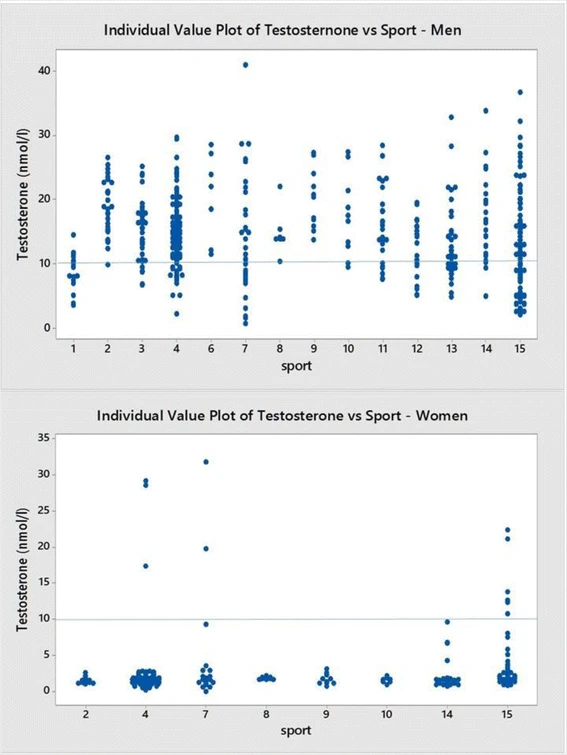
The top graph shows “There were 113 (25.4%) men with a testosterone value less than 10 nmol/l. ” The bottom graph shows”There were 11 of 231 (4.8%) athletes with testosterone level above 10 nmol/l; 3 of 88 swimmers, 2 of 25 rowers and 6 of 48 track and field athletes.” This chart examined “elite athletes” testosterone levels.


Sport numbering: (1) power lifting, (2) basketball, (3) football/soccer, (4) swimming, (5) marathon, (6) canoeing, (7) rowing, (8) cross country skiing, (9) alpine skiing, (10) weight lifting, (11) judo, (12) bandy, (13) ice hockey, (14) handball, (15) track and field.

Source: Sönksen, P. H., Holt, R. I., Böhning, W., Guha, N., Cowan, D. A., Bartlett, C., & Böhning, D. (2018). Why do endocrine profiles in elite athletes differ between sports?. Clinical diabetes and endocrinology, 4(1), 3.

Media links: “How Caster Semenya’s case could alter the landscape of women’s sport”

Fun fact: The first woman to be listed as an Olympic victor was Cynisca of Sparta in 396 B.C.E

Women in baseball

History of women in baseball

The best place to start talking about women’s baseball is too talk about Lizzie Murphy.

In the 1920s, Lizzie played Providence (Rhode Island) Independents as a first baseman and was widely regarded for her fielding ability. She was paid $300 a week (which would be about $3,5858 in 2019), more than most minor league players at the time. Her career lasted from 1918 to 1935. Her dream was to make it to the major leagues, but couldn’t make it, but made it to the semi-professional league.

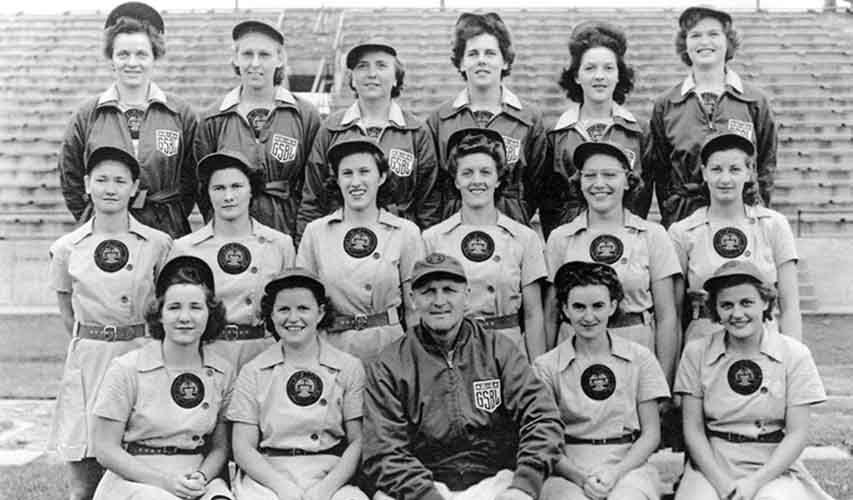
Then World War II came. During WWII, over 500 major league players were drafted, including icons such as Ted Williams, Stan Musial, and Joe DiMaggio (Source). In order to keep the major leagues financially stable during the war, a committee formed the “All-American Girls Professional Baseball League” (AAGPBL) from 1943-1954.

The Rockford Peaches, who won four AAGPBL championships (1945, 1948-1950)

Ila Borders was the first ever female to start a men’s professional baseball game. Ila played from 1997 to 2000, having 52 appearances, 2-4 record, and 36 strikeouts.

Ila Borders (Source)

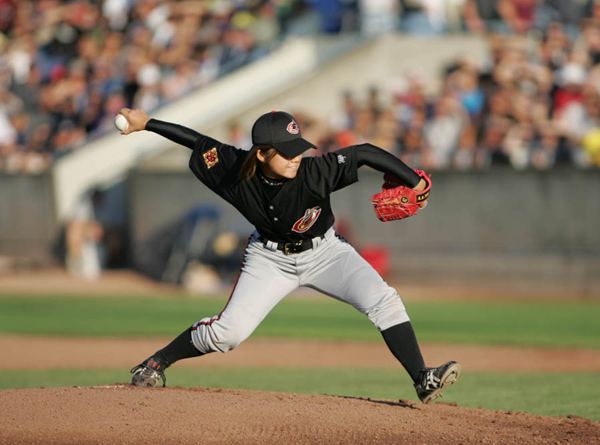
In 2008, Eri Yoshida became the Japan’s first ever female baseball player drafted in a professional men’s league, at age 16. In 2010, she signed a contract with the Chico Outlaws (in California), becoming the first ever woman to play professionally in two countries.

Eri Yoshida, nicknamed the “Knuckleball princess” (Source)

In 2009, Justine Siegal became the first female coach of a professional team, becoming the first base coach for the Brockton Rox (part of the “Can-Am League). In 2011, Siegal became the first woman to have throw a MLB batting practice, for the Cleveland Indians. In 2015, the Oakland Athletics hired her for two weeks as a guest instructor for their instructional league, thus making her the first female coach for a MLB team.

Justine Siegal (Source)

The differences in elite female and male pitchers

The purpose a 2009 study from University of Georgia and the American Sports Medicine Institute was to “Identify the biomechanical features of elite female baseball pitching”. The study examined the kinematics (motions) of eleven elite female and male pitchers, using a high speed camera.

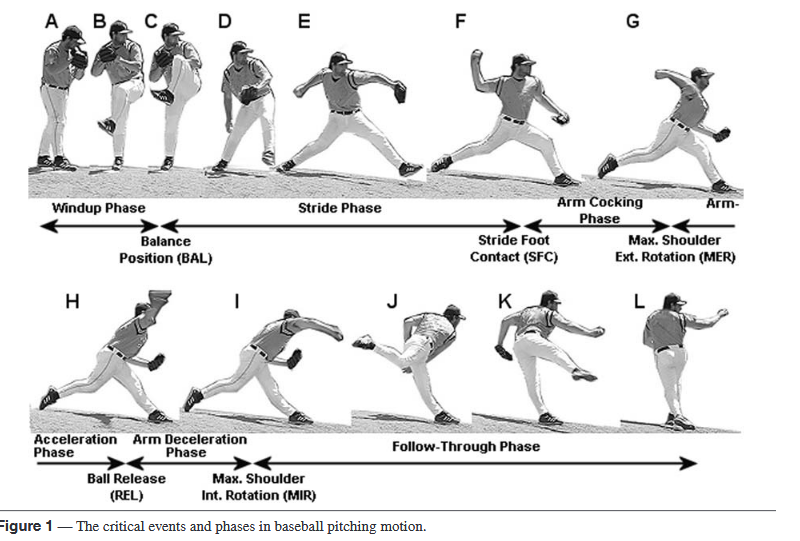
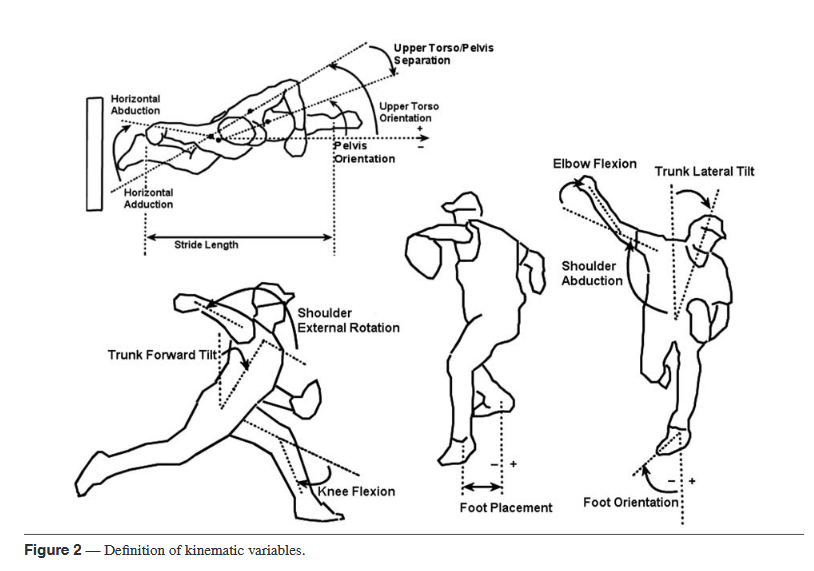
The results of the study showed that females had significantly slower ball velocity. It was also found that females had smaller a smaller stride length and a more open foot stride (front leg was farther out to side during stride), and less upper torso/pelvis separation (distance between the “pelvis orientation” and “upper torso orientation” (fig.2). The study also found that females had less elbow extension velocity (how fast it extended) and less stride knee extension velocity. The study also found that females had a higher knee flexion when releasing the ball (knee was bent more by the time the ball was thrown). It was also found that, for the females, “stride foot contact to ball release” was greater, meaning that it took female pitchers longer to release the ball after the “stride” foot went back down (see fig. 1: B-F phases).

In the discussion section, the study talks about how velocity differences could be explained by the fact the female pitchers tended to rotate their pelvis and upper torso less than the male pitchers. One of the biggest differences that females only lifted their stride leg 3.2 cm above the hips, while males lifted their stride leg 33.1 cm above the hips. The researchers attribute this to the possibility that “due to less muscle strength for females to rotate the trunk back and keep the balance with a high leg kick”. The study also talks about due to the shorter stride and lower leg kick (CDE fig 1), there could be less usable potential energy in the throw. Females also generated 31% less elbow velocity. Ball velocity was found to be significantly lower, and the researchers attribute it to less elbow extension velocity and less knee extension velocity.

The study talks about one of the limitations of the study, and it is a pretty glaring issue.
“although participants were selected to represent elite amateur pitchers in both genders, the female pitchers are real “amateurs,” whereas the male Olympic pitchers may have experienced some professional training in both facilities and schedules.”

The study concludes by saying how though there many differences were quantitative, overall, pitching mechanics were not very different between males and females. The study goes on to suggest that these can be fixed. Open foot placement can be worked on with a pitching coach, while upper torso/ pelvis separation and front knee extension would need technique instruction and strength training.
(Source: Chu, Y., Fleisig, G. S., Simpson, K. J., & Andrews, J. R. (2009). Biomechanical comparison between elite female and male baseball pitchers. Journal of applied biomechanics, 25(1), 22-31.)

Media Links:
Eri Yoshida – AP

Women and Soccer

History of women’s soccer

In the early 20th century, “serious” women’s soccer was common in Great Britain, France, and even Canada. It is believed that competitive soccer wasn’t uncommon in Central Europe (eg. Italy). One of the most well reported games of all time occurred on December 26, 1920, where the Dick, Kerr Ladies took on St. Helen Ladies at Goodison Park in Liverpool. Allegedly, this match had 53,000 spectators and 14,000 who had to be kept out , which held a record for most (women’s match) spectators for 99 years (Source ). Following this game, on December 5, 1921, the Football Association (FA) put a ban on women’s football. The FA claimed that this ban was to “protect” women, but it was stated the real reason was due to the fear that Dick, Kerr “threatened” the men’s game.

Dick,Kerr Ladies in the US, 1922

The ban on Women’s soccer was in effect (in the UK) for 50 YEARS (1971). This ban was a major setback in England women’s soccer. However, women’s teams would played in non-FA areas, such as the United States. Elsewhere in Europe, France and Italy had setup women’s leagues by the 1930s. By 1950, Italy established a national league, and the first informal women’s European championship was held in Germany in 1957. By the time the ban in England was uplifted, 35 countries had national leagues and international competition had become mainstream. ( Source )

US team celebrates winning the 2019 2019 FIFA Women’s World Cup (Richard Heathcote/Getty Images)

Women negotiating gender in soccer

A study from the Norwegian School of Sport Sciences did interviews with professional women’s soccer players (in the US). “The aim was to stimulate the production of narratives and to better understand the content and context of the gender constructions conveyed by the participants.” The interview consisted of three parts.
1.) Demographics background and background in soccer involvement.
2.) Gender socialization as a player
3.) What it is like being an elite female soccer player
The interviews found that the women had to negotiate gender in various aspects and phases of their careers. The interviews found that the women had female role models for soccer, such as their mother, or another elite level female, such as Mia Hamm or Brandi Chastain. The interviews also found that a mothers interest and support was also important in participation of soccer. The study also talks about how 2 players preferred male coaches, while the other 2 players didn’t care about the gender, they only wanted the best coaches. One player even said “I prefer male coaches. Because… he just tells you like it is… Personally, I have never had a female coach, and I don’t want one”. This shows the whole idea about thinking that women can’t say the honest truth.

The interviewees also believed that the popularity in women’s soccer had decreased since another study in 2003, resulting due to the medias lack of interest in the sport and the achievements of women. They also talked about “media invisibility”, where the media doesn’t focus on any of their accomplishments. Another issue this study raises is how female players are displayed “as heterosexually appealing and sexually available”, with one interviewee saying “it is never about performance first in female sport. It is always about the hot-factor… they might mention performance, but it is an afterthought”. The study also talks about how once women adopt physical and social traits that are associated with “masculinity”, their sexual orientations get challenged.

(Source : Kristiansen, E., Broch, T. B., & Pedersen, P. M. (2014). Negotiating gender in professional soccer: An analysis of female footballers in the United States.)

Mia Hamm

Media Links:
The women banned from playing football on the world stage, but did it anyway – BBC News

Women and Basketball

The United States Women’s Olympic team after winning their 6th gold medal in a row in 2016 (https://www.usab.com/news-events/news/2016/08/woly-vs-esp-gold-medal-recap.aspx)

History of women in basketball

Women’s basketball first began at Smith College (Northampton, Mass.) in 1892, when Senda Berenson taught it to improve her students physical health. The very first women’s intercollegiate game took place between Stanford and UC Berkeley in 1896. In 1976, women’s basketball became an official sport of the Olympics, while men’s had been in since 1936. During the 1970s, funding and interest for women’s basketball began to increase due to compliance with Title IX. The very first televised female championship happened in 1979, where Old Dominion beat Louisiana Tech University. By 1982, the NCAA began to officially sponsor women’s basketball. After many attempts at making a professional league, the NBA founded the WNBA in 1996.
Currently, the WNBA consists of 12 teams, while there is 30 NBA teams.

Washington Mystics beat the Connecticut Sun for the 2019 WNBA championship
(Ned Dishman/NBAE via Getty Images )

Women and injuries in Basketball

A study published in American Journal of Sports Medicine from 2006 found that the WNBA had a higher overall game-related injury rate. The WNBA had 24.9 injuries per 1000 “athlete exposures” (players), while the NBA had 19.3 injuries per 1000. The WNBA also saw a higher rates of “Lower extremity” (leg) injuries, with 14.6 injuries per 1000 exposures, while the NBA had 11.6 injuries per 1000. Leg injuries were the most common between both leagues, occurring as 65% of injuries. Lateral ankle sprains were the most common injury, making up 13.7% of diagnose. This study concluded that WNBA players were more susceptible than NBA players, however, there were “few statistical differences in the actual injuries occurring between the 2 leagues”.
(Source: Deitch, J. R., Starkey, C., Walters, S. L., & Moseley, J. B. (2006). Injury risk in professional basketball players: a comparison of Women’s National Basketball Association and National Basketball Association athletes. The American journal of sports medicine, 34(7), 1077-1083.)

How Title IX shaped sports participation

Title IX says “No person in the United States shall, on the basis of sex, be excluded from participation in, be denied the benefits of, or be subjected to discrimination under any educational program or activity receiving Federal financial assistance.”
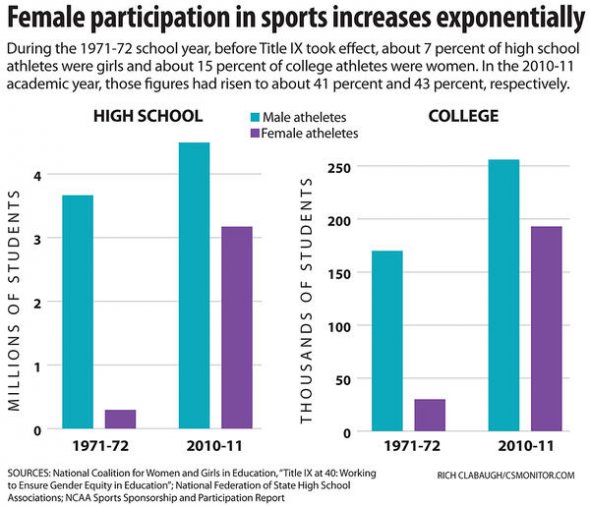
According to the Women’s Sports Foundation, in 1972, when Title IX was passed, “one in 27 girls played sports. Today that number is two in five”.

Media Links:
Mystics beat Sun to win 2019 WNBA championship

Women in Ice Hockey

History of women in ice hockey

Ice hockey began in 19th century Canada, but Women’s teams didn’t start forming until the 20th century. That doesn’t mean that women didn’t play the sport.

This is a picture from the 1890s. The woman in white is actually Lady Isobel Gathorne-Hardy, Daughter of Lord Stanley of Preston, who is the namesake for the Stanley Cup (NHL), with Isobel having the namesake of the NWHL trophy. Women’s teams didn’t start forming until the 1910s and 1920s in colleges in the United States and Canada. In 1921, the first three teams were formed by the Pacific Coast Hockey Association to play for women’s championship. The three teams were the Seattle Vamps, the Victoria Kewpies, and the Vancouver Amazons. The Amazons won and were the only of the three teams who didn’t disband after the 1921 season. As the 20th century went on, College teams became more and more common.

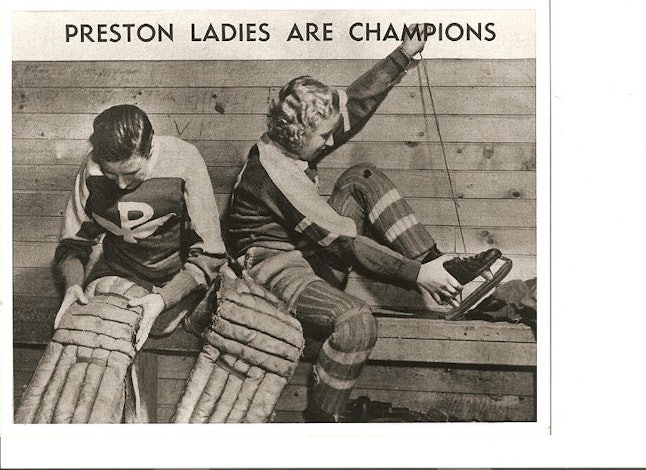
Preston Rivulettes in 1940

Due to Title IX, the 1970s sparked a resurgence in Women’s hockey due to colleges now needing to field a team if they had a men’s team. Women’s ice hockey didn’t appear in the Olympics until 1998, while men’s first appeared in 1920. At the time, there were only 6 teams competing , The United States (Gold), Canada (Silver), Finland (Bronze), China, Sweden, and Japan.

1998 US Women’s Olympic Ice Hockey team

In 2004, the Western Women’s Hockey League (WWHL) was formed. 2 years later, the Canadian Women’s Hockey League (CWHL) was formed. In 2011, the WWHL ended, merging with the CWHL. In 2015, the National Women’s Hockey League (NWHL) was founded with 4 teams, The Boston Pride, Buffalo Beauts, Connecticut Whale, and the Metropolitan Riveters. On May 1, 2019, the CWHL announced it would discontinue due to sponsorship problems with having two leagues . (Source)

2016 Boston Pride, winners of the NWHL inaugural season

Injury rates

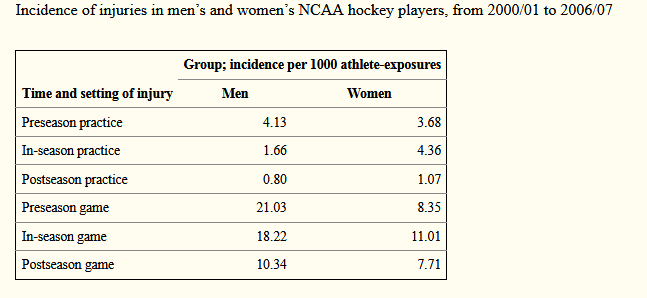
While there is clearly something here being said about the physicality of men’s hockey, this also shows a clear problem. During practices in-season, about 3 more injuries occurred in practice (per 1000) than males, while in postseason, only about a .3 difference “favoring” women, and in preseason, about a .4 difference.
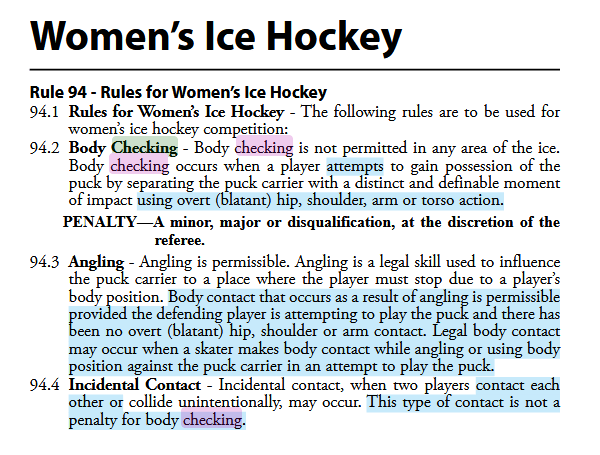
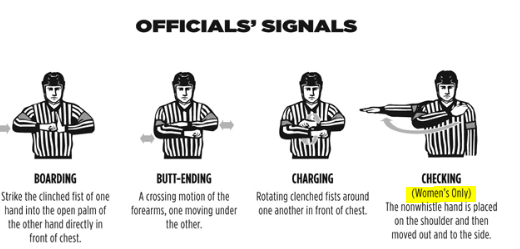
“The rate of concussion was 0.72/1000 AEs for men and 0.82/1000 AEs for women” So women had a .1 more occurrences of concussions. HOWEVER , “Player contact was the cause of concussions in game situations for 41% of women and 72% of men.” There is indeed an explanation for this. In the official NCAA rule book, updated for 2018-2019 and 2019-2020 seasons, the penalty for “checking” is a “woman’s only” rule. This study also found “The concussion rate in women was higher than expected.” A simple explanation of that could be that women are more likely to report a concussion than men.

(Source: Agel, J., & Harvey, E. J. (2010). A 7-year review of men’s and women’s ice hockey injuries in the NCAA. Canadian journal of surgery, 53(5), 319.)

No body checking (NCAA handbook)
From the official NCAA handbook

In a study over 8 year games of World Women’s Under-18 and the Olympic games, 168 injuries were recorded in 637 games, averaging to about 6.4 injuries per 1000 games or even 22 players per 1000 game hours. For an even further breakdown, 2.7 lower body per 1000 games, 1.4 for upper body, 1.3 for head/face, and .9 for spine/trunk(torso). Besides bruising, sprains were the most common injury, knee injuries made up 48.6% of lower body injuries, ligament sprains occurred in 37.1% and ACL tears in 11.4% of knee in injuries. Concussions made up 74.3% of head injuries.
This study also says that the full face protection decreased laceration risks and that there should be more knee, ankle and shoulder prevention methods. Concussion education also needs to be improved for more consistent diagnosis and Return to Play protocols.
(Source: Tuominen, M., Stuart, M. J., Aubry, M., Kannus, P., Tokola, K., & Parkkari, J. (2016). Injuries in women’s international ice hockey: an 8-year study of the World Championship tournaments and Olympic Winter Games. Br J Sports Med, 50(22), 1406-1412.)

Media Links:
“USA defeats Canada to win gold medal”

Manon Rheaume. playing for the Whitecaps in the NWHL, was the first ever female NHL player in 1992 during an exhibition match between Tampa Bay Lightning and the St. Louis Blues.
Dawn Braid became the first ever full time women’s coach in the NHL in 2016, being picked up as the skating coach for the Arizona Coyotes.
Design a site like this with WordPress.com
Get started