History of women in ice hockey
Ice hockey began in 19th century Canada, but Women’s teams didn’t start forming until the 20th century. That doesn’t mean that women didn’t play the sport.

This is a picture from the 1890s. The woman in white is actually Lady Isobel Gathorne-Hardy, Daughter of Lord Stanley of Preston, who is the namesake for the Stanley Cup (NHL), with Isobel having the namesake of the NWHL trophy. Women’s teams didn’t start forming until the 1910s and 1920s in colleges in the United States and Canada. In 1921, the first three teams were formed by the Pacific Coast Hockey Association to play for women’s championship. The three teams were the Seattle Vamps, the Victoria Kewpies, and the Vancouver Amazons. The Amazons won and were the only of the three teams who didn’t disband after the 1921 season. As the 20th century went on, College teams became more and more common.
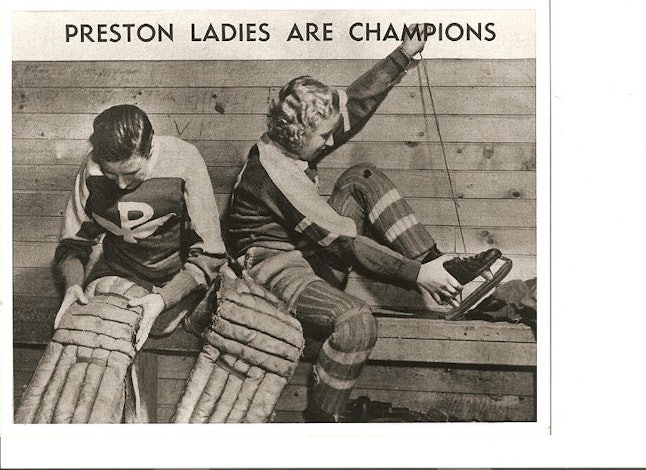
Due to Title IX, the 1970s sparked a resurgence in Women’s hockey due to colleges now needing to field a team if they had a men’s team. Women’s ice hockey didn’t appear in the Olympics until 1998, while men’s first appeared in 1920. At the time, there were only 6 teams competing , The United States (Gold), Canada (Silver), Finland (Bronze), China, Sweden, and Japan.

In 2004, the Western Women’s Hockey League (WWHL) was formed. 2 years later, the Canadian Women’s Hockey League (CWHL) was formed. In 2011, the WWHL ended, merging with the CWHL. In 2015, the National Women’s Hockey League (NWHL) was founded with 4 teams, The Boston Pride, Buffalo Beauts, Connecticut Whale, and the Metropolitan Riveters. On May 1, 2019, the CWHL announced it would discontinue due to sponsorship problems with having two leagues . (Source)

Injury rates
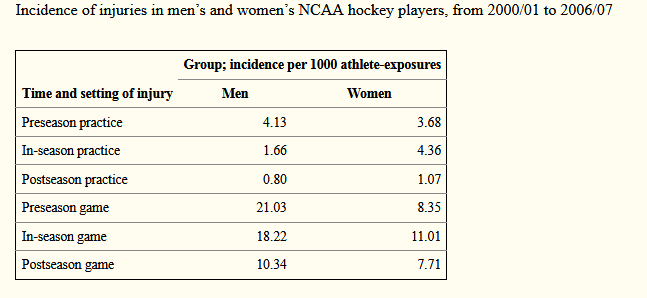
While there is clearly something here being said about the physicality of men’s hockey, this also shows a clear problem. During practices in-season, about 3 more injuries occurred in practice (per 1000) than males, while in postseason, only about a .3 difference “favoring” women, and in preseason, about a .4 difference.
“The rate of concussion was 0.72/1000 AEs for men and 0.82/1000 AEs for women” So women had a .1 more occurrences of concussions. HOWEVER , “Player contact was the cause of concussions in game situations for 41% of women and 72% of men.” There is indeed an explanation for this. In the official NCAA rule book, updated for 2018-2019 and 2019-2020 seasons, the penalty for “checking” is a “woman’s only” rule. This study also found “The concussion rate in women was higher than expected.” A simple explanation of that could be that women are more likely to report a concussion than men.
(Source: Agel, J., & Harvey, E. J. (2010). A 7-year review of men’s and women’s ice hockey injuries in the NCAA. Canadian journal of surgery, 53(5), 319.)
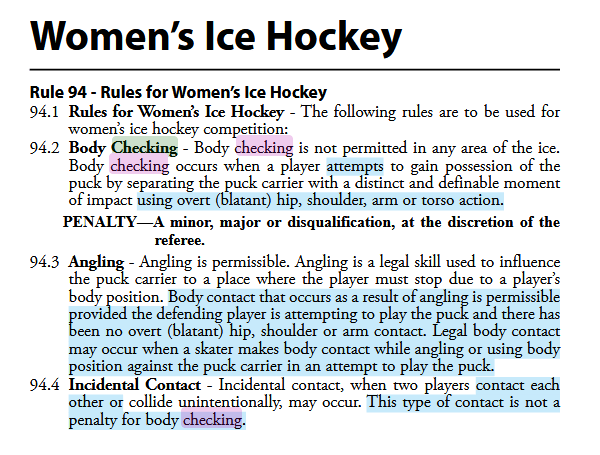
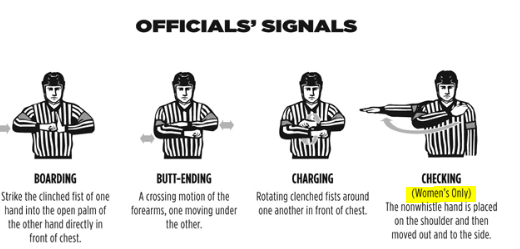

In a study over 8 year games of World Women’s Under-18 and the Olympic games, 168 injuries were recorded in 637 games, averaging to about 6.4 injuries per 1000 games or even 22 players per 1000 game hours. For an even further breakdown, 2.7 lower body per 1000 games, 1.4 for upper body, 1.3 for head/face, and .9 for spine/trunk(torso). Besides bruising, sprains were the most common injury, knee injuries made up 48.6% of lower body injuries, ligament sprains occurred in 37.1% and ACL tears in 11.4% of knee in injuries. Concussions made up 74.3% of head injuries.
This study also says that the full face protection decreased laceration risks and that there should be more knee, ankle and shoulder prevention methods. Concussion education also needs to be improved for more consistent diagnosis and Return to Play protocols.
(Source: Tuominen, M., Stuart, M. J., Aubry, M., Kannus, P., Tokola, K., & Parkkari, J. (2016). Injuries in women’s international ice hockey: an 8-year study of the World Championship tournaments and Olympic Winter Games. Br J Sports Med, 50(22), 1406-1412.)
Media Links:
“USA defeats Canada to win gold medal”


 Women and Sports